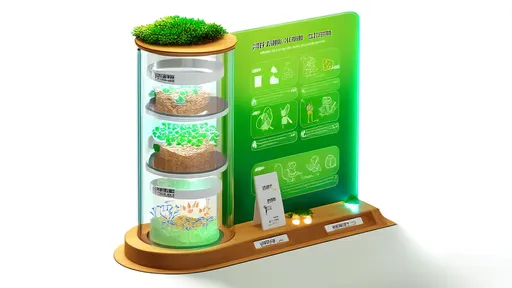
In an innovative approach to urban sustainability education, a new interactive exhibit dubbed the "Compost Eco-Theater" has been turning heads at environmental centers across several cities. The centerpiece of this exhibit is a series of transparent composting jars that vividly display the entire decomposition process of kitchen waste, from fresh scraps to rich humus. This living installation not only demystifies composting but also serves as a powerful visual metaphor for the circular economy.
The concept was born from a collaboration between industrial designers and microbial ecologists who sought to create an engaging educational tool. Each glass vessel acts as a microcosm of decomposition ecology, with carefully layered food waste, garden trimmings, and composting worms visible through the crystal-clear walls. What makes this exhibit extraordinary is its ability to showcase the invisible microbial activity through time-lapse photography projections adjacent to each jar, revealing the dramatic transformation that occurs beneath the surface of ordinary compost piles.
Visitors can observe how different materials break down at varying rates – citrus peels maintaining structure longer than leafy greens, eggshells slowly dissolving into the mix. The exhibit cleverly contrasts industrial composting timelines with home composting methods, using color-coded indicators to track temperature fluctuations and microbial activity levels. This side-by-side comparison has proven particularly effective at helping urban dwellers understand that efficient composting doesn't necessarily require high-tech solutions.
Beyond its educational value, the Eco-Theater has sparked conversations about urban waste management policies. Many visitors report leaving the exhibit with changed perspectives on their own food consumption patterns. The transparent jars make unavoidable the reality of food waste, showing banana peels and coffee grounds not as garbage but as valuable resources in the wrong place. Several community gardens have already adopted scaled-up versions of these display systems for their own educational programs.
Perhaps most innovatively, the designers incorporated "problem waste" sections that demonstrate how non-compostable items disrupt the process. A jar containing plastic bags marked as "biodegradable" shows their persistent presence even as organic matter around them turns to soil, delivering a stark visual lesson about greenwashing in packaging claims. Another jar illustrates how meat scraps attract different decomposers than plant matter, explaining why most home composting systems exclude animal products.
The living nature of the exhibit means it's never the same experience twice. During humid summer months, fungal networks become visible spiderweb-like structures that fascinate children. In cooler seasons, the slowed decomposition process allows visitors to observe intermediate stages often missed in faster cycles. Docents report that these seasonal variations have become teachable moments about how environmental conditions affect microbial ecosystems.
Unexpected outcomes have emerged from the project. Restaurant chefs have begun visiting to better understand how their kitchen waste transforms, leading several establishments to implement more rigorous composting programs. The exhibit has also inspired a citizen science initiative where households receive similar transparent containers to document their composting experiments, creating a crowdsourced database of decomposition rates under different conditions.
As the exhibit travels to new locations, its creators continue refining the concept. Recent additions include augmented reality features that allow visitors to scan jars with their smartphones and see molecular-level breakdown processes. There's talk of developing a home version of the Eco-Theater – perhaps the ultimate testament to its success in making the invisible world of decomposition both visible and fascinating to general audiences.
The Compost Eco-Theater represents a new frontier in environmental education, where scientific processes become dramatic performances and every banana peel has a starring role. By turning decomposition into spectator sport, this innovative approach may well be cultivating the next generation of composting advocates, one transparent jar at a time.

By /Aug 18, 2025

By /Aug 18, 2025

By /Aug 18, 2025

By /Aug 18, 2025

By /Aug 18, 2025
By /Aug 18, 2025
By /Aug 18, 2025

By /Aug 18, 2025

By /Aug 18, 2025

By /Aug 18, 2025
By /Aug 18, 2025

By /Aug 18, 2025

By /Aug 18, 2025

By /Aug 18, 2025

By /Aug 18, 2025

By /Aug 18, 2025

By /Aug 18, 2025

By /Aug 18, 2025

By /Aug 18, 2025

By /Aug 18, 2025
