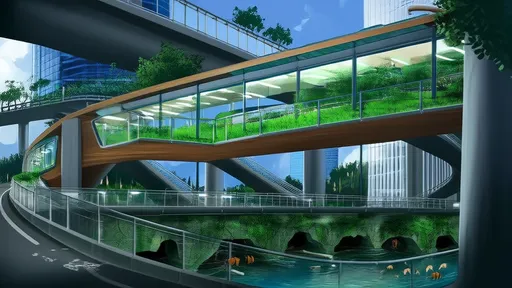
In the heart of bustling urban landscapes, where concrete jungles dominate, a quiet revolution is taking place. Cities around the world are reimagining their infrastructure to accommodate not just human needs but also the delicate ecosystems that coexist within them. One such innovation gaining traction is the concept of ecological overpasses—specifically designed insect corridors spanning highways. These structures, often overlooked in traditional urban planning, are proving to be vital in preserving biodiversity and maintaining ecological balance.
The idea of building bridges for insects might seem whimsical at first glance, but the science behind it is anything but. Highways, while essential for human connectivity, act as formidable barriers for small creatures like insects. These roads fragment habitats, disrupt migration patterns, and contribute to declining insect populations—a crisis with far-reaching consequences for pollination, soil health, and food chains. Ecological corridors offer a lifeline, allowing species to traverse these man-made divides safely.
Take, for instance, the pioneering project in Munich, Germany, where a green overpass was constructed to reconnect two sections of a forest severed by a busy autobahn. Unlike traditional wildlife crossings tailored for larger animals, this structure was meticulously planted with native vegetation, providing a familiar and nourishing pathway for insects. Early observations revealed not just an increase in insect traffic but also a resurgence of bird species that rely on them for food. The success of this project has sparked similar initiatives in Switzerland, the Netherlands, and even urban centers in Asia.
Designing these insect highways is no simple feat. Engineers and ecologists collaborate to determine optimal locations, often using GIS mapping to identify critical migration routes. The bridges themselves must mimic natural habitats as closely as possible. This means selecting the right mix of plants—flowering species to attract pollinators, shrubs for shelter, and even decaying wood for beetles. Materials matter too; recycled composites and porous surfaces are favored to blend functionality with sustainability. The goal is seamless integration, where the structure feels less like an artificial add-on and more like an extension of the landscape.
Critics argue that the costs of these projects outweigh their benefits, especially when budgets are tight. However, advocates counter that the long-term ecological payoffs are immeasurable. Insects are the unsung heroes of ecosystems, responsible for pollinating 75% of flowering plants and forming the base of countless food webs. Their decline, accelerated by habitat loss, could trigger cascading effects far beyond what we currently comprehend. Investing in insect corridors is, in essence, investing in the resilience of entire ecosystems.
Beyond environmental benefits, these structures offer unexpected social value. In Seoul, a disused highway overpass was transformed into a pollinator-friendly garden, doubling as a public park. Locals now stroll through a thriving green space alive with butterflies and bees, a stark contrast to the sterile infrastructure that once stood there. This dual-purpose approach not only garners public support but also raises awareness about urban biodiversity, fostering a deeper connection between city dwellers and the natural world.
The future of urban insect corridors looks promising but hinges on broader adoption. While European cities lead the charge, North America is catching up, with pilot projects in Toronto and Portland studying how native species interact with these crossings. Researchers are also exploring innovative technologies, such as UV-reflective coatings to guide nocturnal insects and AI-powered monitoring systems to track usage patterns. The data collected could refine designs, making future corridors even more effective.
As climate change intensifies and urban sprawl continues, the need for creative ecological solutions becomes ever more urgent. Insect overpasses represent a small but significant step toward harmonizing human progress with nature’s rhythms. They remind us that cities, often seen as antithetical to wilderness, can—and must—become sanctuaries for all forms of life. The next time you’re stuck in traffic, look up: you might just spot a butterfly highway overhead, a silent testament to what’s possible when we build with more than ourselves in mind.
By /Aug 18, 2025
By /Aug 18, 2025

By /Aug 18, 2025

By /Aug 18, 2025

By /Aug 18, 2025
By /Aug 18, 2025
By /Aug 18, 2025

By /Aug 18, 2025

By /Aug 18, 2025

By /Aug 18, 2025

By /Aug 18, 2025

By /Aug 18, 2025

By /Aug 18, 2025

By /Aug 18, 2025

By /Aug 18, 2025

By /Aug 18, 2025

By /Aug 18, 2025

By /Aug 18, 2025

By /Aug 18, 2025

By /Aug 18, 2025
